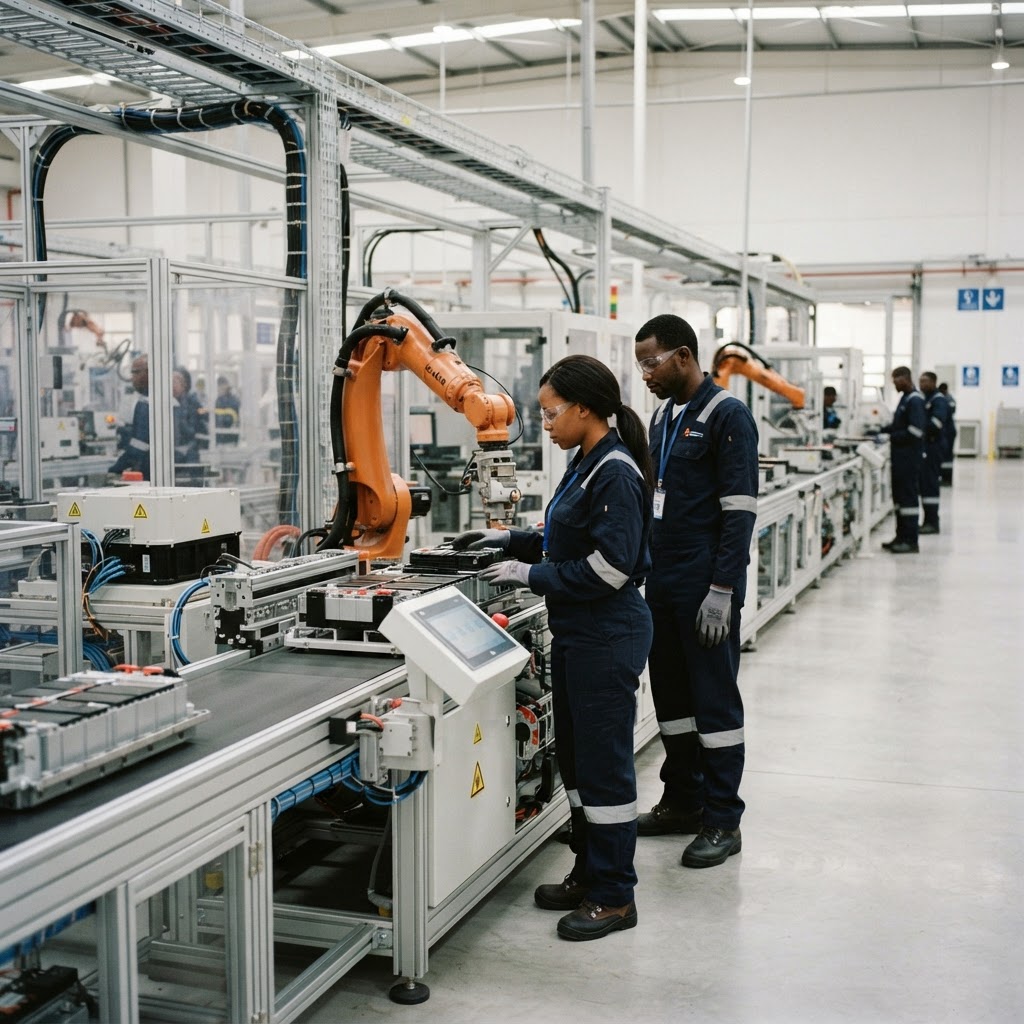
Industrial edge computing is the deployment of compute and storage capacity close to industrial operations, mines, plants, rail lines and ports, so that time-critical data is processed locally, with only summaries and non-urgent data sent upstream.
Executive summary
- 01Edge nodes at industrial sites process sensor, video and machine data locally, removing latency and bandwidth constraints.
- 02Local processing keeps operational data in-country, a direct expression of digital sovereignty.
- 03Edge capacity along a corridor creates a distributed industrial data platform serving mines, rail and ports simultaneously.
Why the cloud alone is not enough
A mining operation generates terabytes of data daily: high-resolution video, machine telemetry, geological surveys, environmental sensors. Sending all of it to a distant cloud is slow, expensive and fragile when links fail. More importantly, several workloads cannot tolerate round-trip latency at all, autonomous vehicle control, safety systems, real-time video analytics. Edge computing places the processing where the machines are.
Edge and sovereignty
When operational data is processed at the site where it is generated, it can remain under the operator's, and the state's, jurisdiction. Edge architecture is therefore also a sovereignty architecture: sensitive production and logistics data never needs to leave the country, while only aggregated, non-sensitive information is shared with global systems. For corridor states balancing investment attraction with data control, edge computing resolves much of the tension.
The corridor as distributed data platform
Individual edge nodes are useful; a corridor of them is a platform. Edge capacity sited at mines, rail nodes and the port terminal can share workloads, replicate services for resilience, and host the corridor's shared applications, traceability, customs digitization, predictive maintenance. Corridor-Zero designs edge capacity as part of the same trusted network fabric as the 5G layer, so compute lands wherever operations need it.