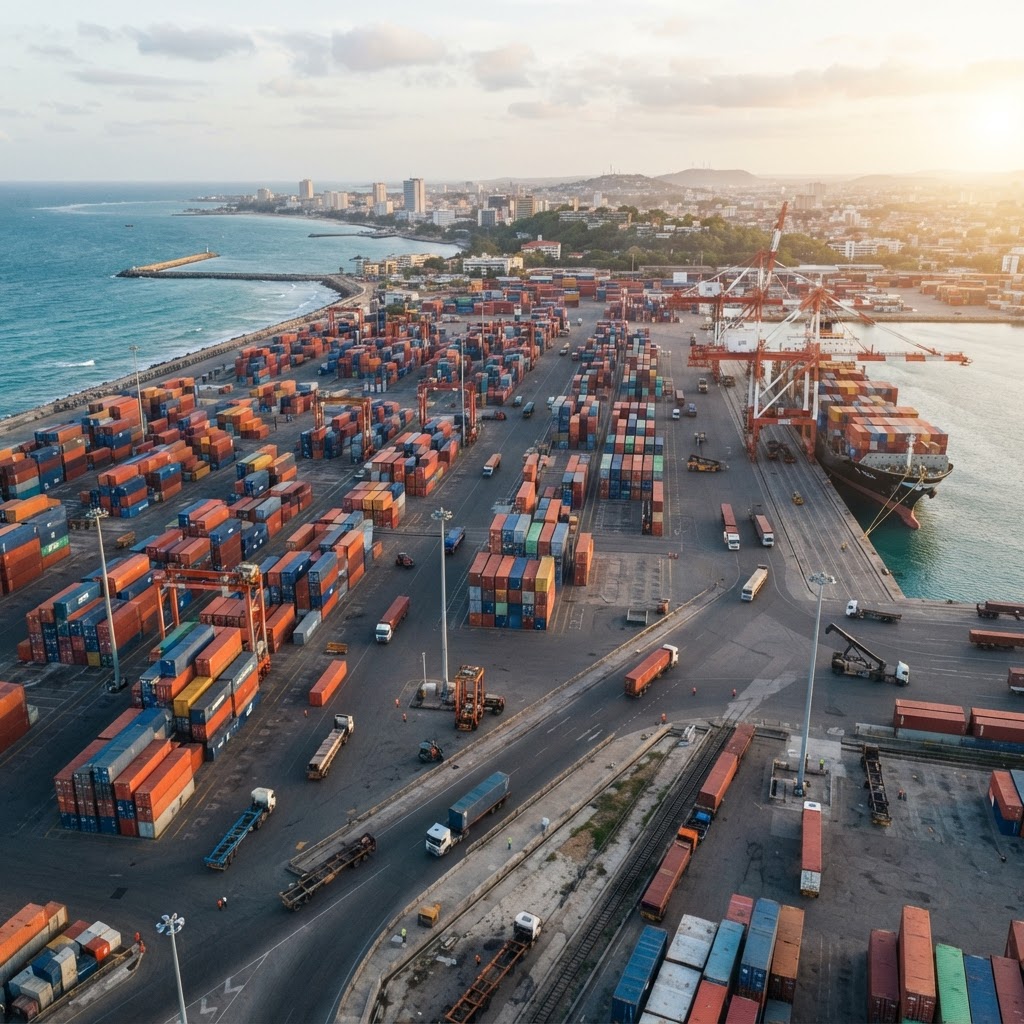
The Lobito Corridor is the logistics and trade route linking the cobalt and copper belts of the Democratic Republic of the Congo and Zambia through Angola to the Atlantic port of Lobito — and, increasingly, the name for the integrated corridor economy being built around that route.
Executive summary
- 01The corridor connects some of the world's most important copper and cobalt reserves to Atlantic export markets via the Benguela railway.
- 02Its next phase depends on digital infrastructure: private 5G along the rail alignment, corridor-wide connectivity, edge data capacity and secure cross-border systems.
- 03Corridors that pair physical assets with trusted digital layers attract better capital, better offtakers and better industrial tenants.
A corridor rebuilt for a new mineral age
The Benguela railway's rehabilitation restored a direct rail link between the Central African copperbelt and the Atlantic for the first time in decades. Freight that once spent weeks overland now moves on a predictable schedule toward Lobito. But the corridor's ambition is larger than rail: governments, the U.S. administration, the EU and development financiers describe it as a demonstration of how strategic corridors should be developed — transparently, commercially, and with partners who build trust into the infrastructure itself.
The digital layer decides the ceiling
Every phase of corridor growth increases demands on the digital layer. Tracking cargo along the route requires rail-side connectivity. Coordinating border crossings between Angola, DRC and Zambia requires shared, secure data systems. Attracting processing plants and industrial parks requires the same standard of connectivity and edge computing that industrial investors expect anywhere else. A corridor's throughput ceiling is set not by track and berth capacity alone, but by how much information can move reliably across it.
What comes next
Expect the corridor's development to proceed in layered stages: first mission-critical connectivity for rail and port operations, then corridor-wide private networks serving mines and logistics parks, then the data platforms — traceability, customs digitization, energy management — that turn the route into a governed digital corridor. Corridor-Zero's role is to build that trusted digital layer so the physical investment compounds instead of stalling.